You Only Sell a Business Once: Why an ERP Decision Is Also a Valuation Decision for Founder-Owned Manufacturers

For an owner whose business will transact once, recurring cost removed by an ERP implementation is not simply next year’s profit. It is capitalized by a buyer at a multiple, and it changes the multiple that buyer applies to every existing dollar of earnings.
Manufacturing owners are routinely asked to evaluate an ERP investment as an IT project, judged on payback period and internal rate of return. For a founder- or family-owned business, that framing understates the decision by an order of magnitude because a buyer capitalizes recurring profit and prices confidence in it separately.
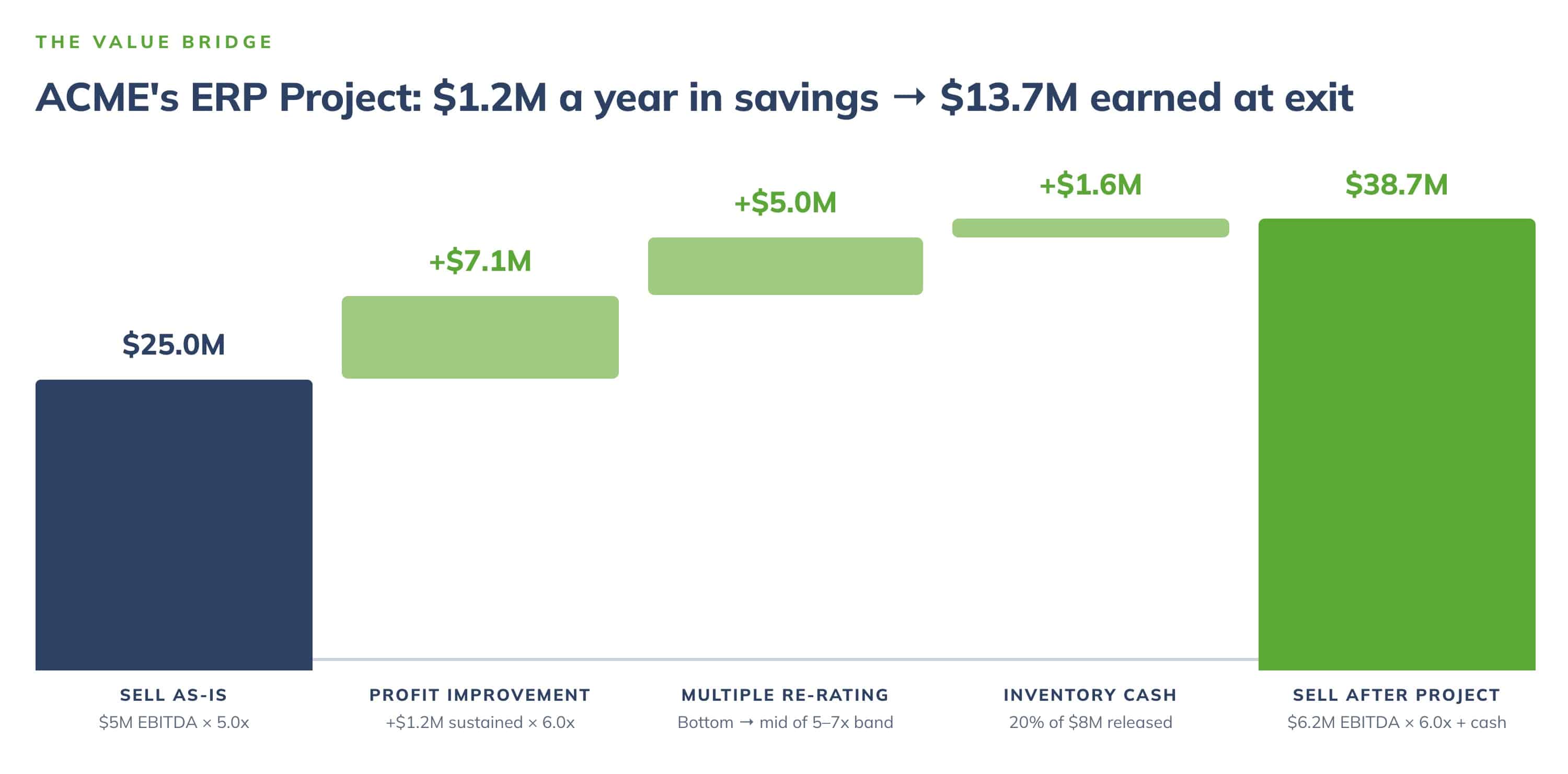
Those two effects compound. In the illustrative case below, for a $50 million revenue industrial manufacturer with $5 million of EBITDA, $1.2 million a year of sustained savings is associated with $13.7 million of additional value at sale, a 55% increase over the same business sold as it stands. Roughly a third of that increase has nothing to do with the savings themselves.
About this series
Ownership structure determines how a dollar of recurring profit is valued. The same $1.2 million of annual ERP-driven savings is worth a different amount, and has to be defended in a different way, to a founder, a financial sponsor and a public-market investor. The Equity Value Series examines all three ownership scenarios:
- Article 1 — Founder- and Family-Owned: You Only Sell a Business Once.
How does sustained cost removal translate into sale proceeds? Why does the multiple itself move, and what does diligence reward? - Article 2 — Private Equity-Backed: Every Dollar of EBITDA Exits at the Multiple.
How does operational improvement flow through a levered structure to sponsor equity? What survives a quality-of-earnings review, and what does not? - Article 3 — Publicly Traded: The Earnings Investors Capitalize.
Which improvements do analysts capitalize into the multiple, and which get looked through as one-time? What does the same earnings accretion cost any other way?
In this article, the first of three, we examine how sustained operational improvement delivered by a modern ERP translates into enterprise value for an owner, and why timing relative to a sale process determines how much of it the owner is paid for.
Most of the owner’s net worth is a single, illiquid position
Published wealth studies of private business owners consistently place roughly 80% of net worth inside the company. For a founder- or family-owned manufacturer, the business and the retirement plan are the same asset. The retirement plan, in practice, is the sale.
That concentration is rarely matched by a corresponding focus on sale readiness. Estimates of how many listed businesses actually close cluster between 20% and 30%, meaning 70% to 80% do not transact at all. Those deals rarely fail on the quality of the product or the loyalty of the customer base. They fail in diligence, and disproportionately on two things a buyer must verify independently: inventory accuracy and auditable financial records.
The illustrative case: ACME Industries
ACME Industries is a family-owned industrial manufacturer with $50 million in revenue and $5 million of EBITDA, running on spreadsheets and QuickBooks rather than an ERP system. It carries $8 million of inventory (~16% of revenue). The founder expects to sell but has not started a process.
Valued as it stands, ACME is worth approximately $25 million: $5 million of EBITDA at 5.0x, the bottom of a published band for general industrial manufacturers of this profile. It is the bottom because none of it — inventory, margins, the order book — can be confirmed independently. A buyer has to take ACME’s numbers on trust.
An ERP decision moves that figure through three effects.
Effect one: recurring cost removal is capitalized, not banked
ACME loses approximately $1.2 million a year to costs that sit in three different places on the P&L and are never attributed to the system that produces them: scrap identified at month-end rather than at the machine, expedited freight covering promise dates that were estimated rather than calculated, and labor absorbed by re-keying orders between QuickBooks, spreadsheets and email. The right ERP can remove all three. A conventional ROI case finds them and values them as an annual saving. That is the wrong unit.
The right unit is the multiple. None of this is new revenue; it is cost the business already pays every month. But because a buyer pays a multiple of sustained profit, every recurring dollar that stops leaving the business is worth many times that dollar at closing. At the mid-band multiple used in the post-improvement case, $1.2 million of sustained savings is worth approximately $7.1 million at sale.
Savings a buyer can trace to a system of record, such as a modern cloud ERP, are credited as durable earnings; savings that trace only to a management assertion are adjusted out.
Effect two: the multiple re-rates on every existing dollar of earnings
Buyers are not only pricing earnings; they are pricing their confidence in those earnings. When inventory counts cannot be verified, when each diligence request takes a week to answer, and when the financial record depends on the founder being in the room, buyers protect themselves by discounting to the bottom of the multiple band, or by withdrawing.
The same company running a modern cloud ERP and presenting real-time inventory accuracy, auditable financials and processes that transfer to a new owner is not discounted at all. Each of those characteristics is priced upward. Moving from the bottom of the band (5.0x) to the middle (6.0x) adds approximately $5 million on ACME’s existing $5 million of EBITDA. The multiple re-rates on every existing dollar of earnings, not only on the improvement. That makes it additive to the $7.1 million already credited to the savings, not a multiplier.
This is the largest contributor after the savings themselves, and the least expensive value in the bridge. It requires no growth, no new customers and no margin expansion. It only requires that the business be legible to someone who did not build it. A unified ERP system makes it legible: one set of records, current and verifiable, that a buyer can test without the founder in the room.
Effect three: inventory that exists because nobody trusts the data
When the count is not trusted, every function buffers: purchasing over-orders, production builds ahead, and the balance sheet accumulates inventory that insures against bad data rather than responding to demand. ACME’s $8 million of inventory, at 16% of revenue, sits above where a comparable manufacturer running an ERP with real-time visibility and MRP-driven planning would operate.
Releasing approximately 20% of that position returns $1.6 million in cash to the owner: a one-time release, shown alongside the bridge rather than capitalized at the multiple.
Beyond the bridge: the data foundation the next decision depends on
Applied AI in manufacturing (e.g., demand sensing, planning, quality prediction, automated document handling) depends on operational data that is current, complete and structured. A manufacturer running on spreadsheets and a disconnected general ledger cannot adopt those capabilities regardless of intent, because there is no reliable data foundation to act on.
Acquirers have begun to price this directly. They increasingly assess whether a target is positioned to adopt those capabilities or will need an ERP replacement first. That assessment is becoming part of how confidence is priced, which makes it part of the multiple conversation rather than a separate technology conversation.
The figures are deliberately conservative
The credibility of this analysis rests on its arithmetic surviving scrutiny from a buyer, a banker or an accountant. Several constraints are applied for that reason, and each reduces the result:
- The as-is case is valued at the bottom of the published multiple band; the post-improvement case at the middle, not the top. Valuing ACME at the top of the band would add a further $6.2 million.
- One-time working capital release is never multiplied.
- Back-office improvement is treated as capacity repurposed to higher-value work, building to a run rate over the years preceding a transaction. It is not day-one headcount reduction.
- Where sustained savings would represent an unusually large share of current earnings, figures are presented as an upper bound, because the underlying benchmarks were measured on manufacturers operating at 10% to 15% margins.
Conclusion
An owner who will sell once does not get a second attempt at the condition of the business at the moment of sale. Buyers credit what is already in the run rate when the process begins; improvements still in flight are discounted as unproven, and improvements promised are not credited at all.
That makes timing, not magnitude, the variable most within the owner’s control. The same $1.2 million delivered three years before a process is worth its full multiple. Delivered during the process, it is worth an argument.
With roughly 80% of net worth in a single position, exit readiness is not a decision to sell. It is the ability to sell, hand down or hold, on the owner’s timeline and at full value. The owners who have that choice fixed the operation, by way of a modern ERP system, before they needed to.
Next in this series:
The second article examines the same improvement inside a private equity-backed portfolio company, where fixed acquisition debt sends every incremental dollar of exit value straight to sponsor equity. The third looks at a publicly traded manufacturer, where it is taxed, capitalized at a P/E and measured in EPS.
To see what this analysis looks like against a specific set of company figures, the Equity Value Quiz generates the same bridge in about three minutes.
About the analysis
All figures in this series are illustrative estimates for a hypothetical company, derived from a single model applied across the three ownership structures. Benchmarks are drawn from published sources including NYU Stern/Damodaran January 2026 working-capital and margin data; CT Acquisitions and The Precision Firm 2026 manufacturing multiples; Rootstock and Forrester ERP benefit studies; and BLS employer cost data. They are not a valuation opinion, investment advice, or a prediction of any company’s sale price or share-price performance.