Every Dollar of EBITDA Exits at the Multiple: How an ERP Program Drives Sponsor Returns When Multiple Expansion Doesn’t

Acquisition debt is fixed, so every incremental dollar of exit enterprise value lands undiluted in the equity account. That makes recurring, auditable ERP-driven cost removal one of the few levers that still moves a sponsor return.
The arithmetic of sponsor returns has changed. Bain & Company’s widely cited framing, that roughly 12% annual EBITDA growth is now required to deliver the return that 5% used to deliver, reflects high entry multiples, exit multiple expansion that can no longer be assumed, and leverage that costs more than it did when many current portfolios were assembled. The return has to come from operations.
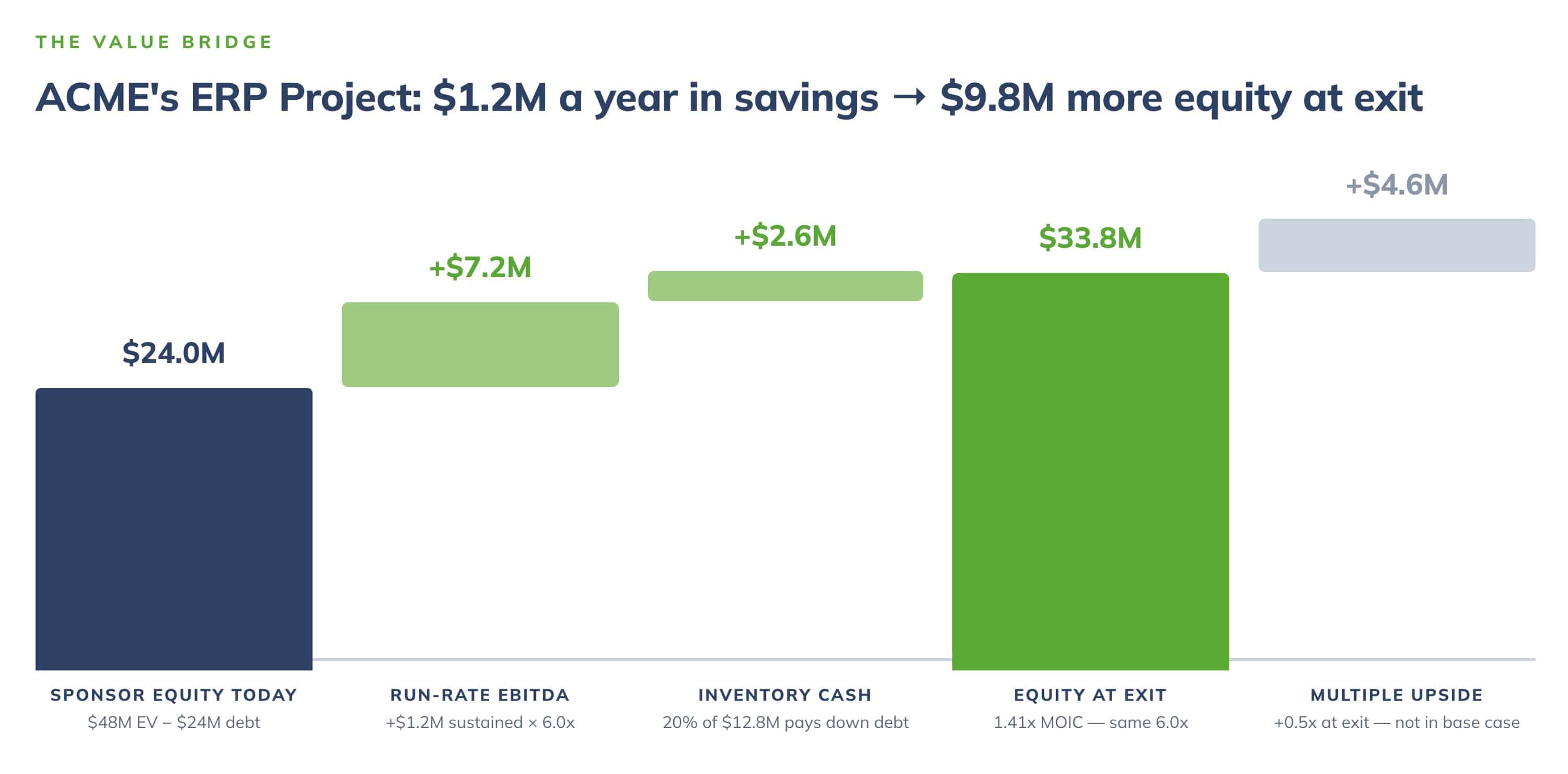
Within that constraint, ERP-driven cost removal has two properties most value-creation levers lack: it reaches EBITDA directly rather than through a volume assumption, and it recurs. In the illustrative case below, for an $80 million revenue portfolio company acquired at 6.0x with 50% debt, the ERP program is associated with $9.8 million of incremental sponsor equity at exit, or 0.41 turns of MOIC, with the exit multiple held flat at entry.
In this article, the second of three, we examine how operational improvement flows through a levered structure to equity, what a quality-of-earnings review will and will not credit, and why data quality has become a deal risk in its own right.
The unit of account is sponsor equity, not enterprise value
Acquisition debt is fixed. The business can be worth more at exit than it was at entry, but the loan does not grow with it, so every additional dollar of exit value belongs to the equity holders.
That is what makes a small operating improvement look large. ACME’s $1.2 million of savings is 1.5% of revenue, which reads as a rounding error. But the sponsor does not own revenue; in the case below it owns $24 million of equity, and that is the denominator that matters.
The illustrative case: ACME Industries
ACME Industries is a PE-backed industrial manufacturer with $80 million of revenue and $8 million of EBITDA, acquired at 6.0x: a $48 million enterprise value, financed with 50% debt, leaving $24 million of sponsor equity. It runs an aging on-premise ERP and carries $12.8 million of inventory (~16% of revenue). Meeting the sponsor’s target return across a five-year hold requires sustained EBITDA growth, and every dollar of it has to be defensible at exit.
Savings are credited only when they trace to a mechanism
ACME’s plan identifies $1.2 million of run-rate EBITDA improvement. What matters more than the figure is that it decomposes into three named mechanisms:
- 1% of revenue in COGS efficiency: scrap reduction, expedited freight avoidance and materials planning improvement from real-time production and inventory data.
- 2.5 back-office FTE-equivalents of capacity repurposed: effort absorbed by reconciliation, re-keying and manual reporting, redirected to higher-value work over the hold rather than removed on day one.
- The legacy ERP estate retired: licensing, infrastructure and the internal IT labor attached to maintaining it.
When the next buyer’s quality-of-earnings team tests the adjustments, savings auditable in the system of record are credited as sustainable EBITDA. Savings supported only by a management assertion are struck, and a percentage applied to a cost base is a management assertion.
At the flat 6.0x entry multiple, $1.2 million of credited run-rate improvement is worth $7.2 million at exit, all of it to equity.
Buffer inventory is financed with sponsor capital
ACME’s $12.8 million inventory position is 16% of revenue, and a meaningful share of it is buffer stock compensating for planning data no function fully trusts. That is not a working capital policy; it is the cost of uncertainty, carried on capital the sponsor put in.
MRP-driven planning and real-time ERP visibility release approximately 20% of that position as cash during the hold: $2.6 million, applied against acquisition debt. Every dollar of debt retired is a dollar in the equity account at close. As in the first article, the release is shown alongside the bridge rather than capitalized at the multiple.
Poor data quality is a deal risk, not an IT issue
Sponsors who have carried a portfolio company through a sale process with weak operational data describe the same pattern. Diligence stalls. Adjustments the seller believes are self-evident are rejected for lack of support. Data room requests that should take hours take weeks, and the elapsed time itself becomes a signal. Buyers respond by discounting the price or, in the less forgiving cases, by walking.
Clean, auditable data is what makes a business straightforward to sell. An integrated cloud ERP hands the next owner a finance function that closes quickly, numbers that hold up, and increasingly the operational data foundation on which that owner can apply AI to the workflows they expect to be automated. A buyer assessing whether a platform is ready for that, or whether it first needs an ERP replacement, is making a pricing judgment.
If that readiness earns even half a turn at exit, moving the multiple from 6.0x to 6.5x, it is worth a further $4.6 million on ACME’s improved $9.2 million of EBITDA. That figure is shown as upside and excluded from the base case, which holds the exit multiple flat at the 6.0x entry.
Timing determines how much of it is credited
Savings that reach the run rate in year one are credited in full at exit. The identical savings delivered in year four are discounted as unproven, because a buyer has no trailing period in which to observe them. The improvement is the same; the credit is not. An operating plan that defers a systems decision to year three is, in effect, choosing to fund the work and forgo most of its exit value.
Conclusion
Where multiple expansion cannot be assumed and leverage is expensive, the levers that remain are the ones that reach EBITDA directly and persist. Cost removal traced to a system of record does both, and it is credited at exit in a way that cost removal traced to a management assertion is not.
The case here holds the exit multiple flat, treats back-office improvement as capacity repurposed rather than headcount removed, and keeps a one-time working capital release outside the multiple. Each of those choices reduces the result. They are made deliberately, because the only durable asset in a value-creation argument is that it survives the next buyer’s review.
Next in this series:
The third article examines the same improvement at a publicly traded manufacturer, where the decisive question is not how much is saved but whether an analyst will carry it into the out-years.
To see what this analysis looks like against a specific set of portfolio company figures, the Equity Value Quiz generates the same bridge in about three minutes.
About the analysis
All figures in this series are illustrative estimates for a hypothetical company, derived from a single model applied across the three ownership structures. Benchmarks are drawn from published sources including NYU Stern/Damodaran January 2026 working-capital and margin data; CT Acquisitions and The Precision Firm 2026 manufacturing multiples; Rootstock and Forrester ERP benefit studies; and BLS employer cost data. They are not a valuation opinion, investment advice, or a prediction of any company’s sale price or share-price performance.